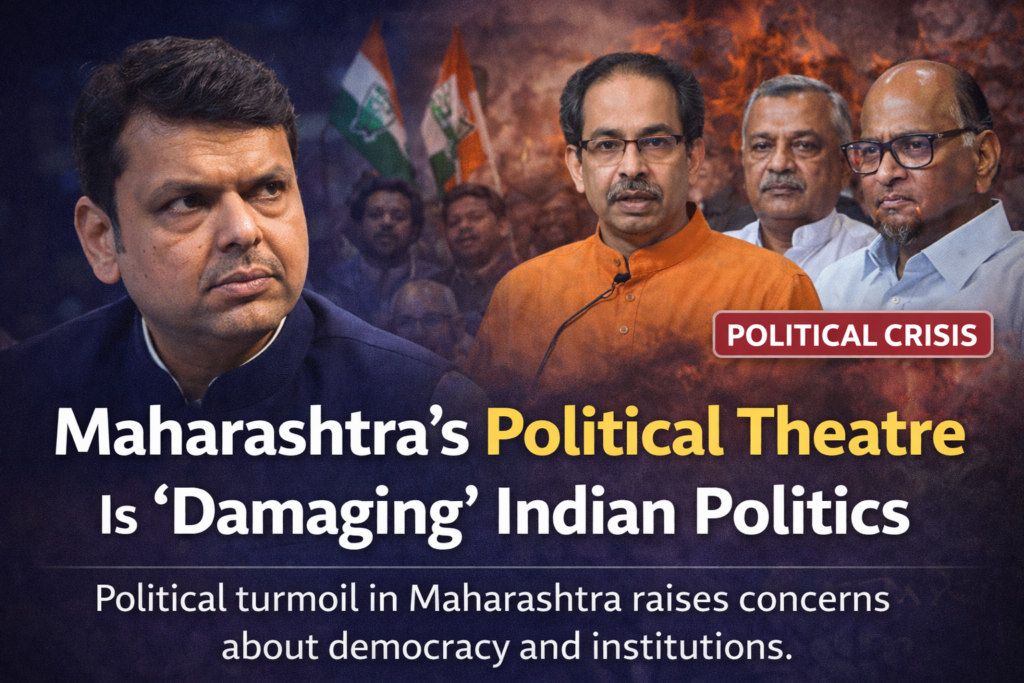
Maharashtra political arena has once again placed Indian democracy under intense scrutiny. The dramatic resignation of Maharashtra Chief Minister Devendra Fadnavis after just three days in office has raised serious questions about political ethics, institutional neutrality, and the health of competitive politics in India.
The crisis unfolded after India’s Supreme Court ordered a floor test to determine majority support in the state assembly. What followed was a chain of events that many observers describe as a troubling episode in India’s democratic evolution. The developments in Maharashtra political theatre are not just about one state government; they reflect deeper structural tensions in Indian politics.
Join our social media platform
How the Maharashtra Political Arena Began
The 288-seat Maharashtra assembly elections produced a fractured mandate. The Bharatiya Janata Party (BJP) emerged as the single largest party with 105 seats, followed by its long-time ally Shiv Sena with 56 seats. The opposition — the Nationalist Congress Party (NCP) and Congress — secured fewer than 100 seats combined.
Under normal circumstances, the BJP-Shiv Sena alliance was expected to form the government comfortably. However, disagreements over power-sharing arrangements led to the collapse of the alliance.
This marked the beginning of what would soon evolve into Maharashtra political theatre — a sequence of defections, resort politics, surprise alliances, and an early-morning swearing-in ceremony that stunned the country.
The Early Morning Swearing-In Controversy
In a dramatic turn, Devendra Fadnavis was sworn in as Chief Minister in an early morning ceremony, along with a breakaway faction leader from the opposition camp. The move surprised political observers and triggered immediate legal challenges.
Critics questioned the governor’s role in hastily administering the oath without a transparent verification of majority support. Political scientist Suhas Palshikar described this as a serious institutional lapse, arguing that the governor’s office should remain neutral in such contested situations.
A landmark 1994 Supreme Court judgment clearly established that majority claims must be tested through a floor vote in the assembly. Yet the rapid sequence of events in Maharashtra political theatre raised concerns about institutional propriety.
Supreme Court Intervention and Resignation
The Supreme Court intervened and ordered a floor test within a specified timeline. Facing the prospect of losing the confidence vote, Fadnavis resigned just days after taking office.
The episode concluded with a new coalition forming government, but the damage to public trust had already been done. Maharashtra political theatre had transformed from a state-level power struggle into a national debate about democratic integrity.
What the Crisis Reveals About Indian Politics
1. Fluid Alliances and Opportunism
Post-election alliances are not new in Indian politics. However, the scale and speed of shifting loyalties in Maharashtra political theatre highlighted the increasingly transactional nature of power politics.
Political ideologies appeared secondary to numerical arithmetic. Former allies became rivals, and rivals became partners almost overnight.
2. Institutional Concerns
Observers argue that institutions such as the governor’s office, the Election Commission, and even judicial timelines are increasingly scrutinized for perceived bias.
When constitutional offices appear to act in ways that benefit one political formation, it fuels public skepticism.
3. Competitive Politics Under Strain
Dr. Palshikar suggested that Maharashtra political theatre has caused “durable damage” to competitive politics. When parties prioritize tactical maneuvers over transparent governance, public faith in democracy weakens.
Public Reaction: Why Limited Outrage?
One striking aspect of Maharashtra political arena was the relative absence of widespread public protest.
Several factors may explain this:
- Political fatigue among citizens
- Normalization of defections and resort politics
- Weak mass mobilization outside organized party structures
- Growing preference for strong leadership models
A Pew Research survey in recent years indicated that many Indians prefer strong executive leadership even if it limits parliamentary interference. This mindset may reduce resistance to aggressive political strategies.
Media and the Spectacle of Politics
News networks often presented Maharashtra political arena as high drama, comparing it to a Bollywood plot twist. Political events increasingly resemble entertainment spectacles, blurring the line between governance and performance.
This media framing contributes to the normalization of political maneuvering.
The Larger Democratic Question
The Maharashtra political arena episode forces a deeper question: Are India’s democratic institutions resilient enough to withstand aggressive competitive politics?
Democracy depends on:
- Transparent floor tests
- Neutral constitutional authorities
- Respect for electoral mandates
- Ideological consistency
- Ethical political conduct
When these pillars weaken, governance becomes unstable and unpredictable.
Historical Context of Political Instability
India has experienced coalition governments and shifting alliances before. However, the intensity and speed of maneuvering in Maharashtra political theatre stood out for its theatrical timing and legal urgency.
The episode underscores the evolving nature of Indian federal politics, where regional dynamics increasingly influence national narratives.
Impact on Governance and Investor Confidence
Maharashtra is India’s richest state and home to Mumbai, the country’s financial capital. Political instability in such a crucial economic hub has broader implications.
Frequent government formation crises may affect:
- Investor confidence
- Policy continuity
- Administrative efficiency
- Development planning
Stable governance is essential for economic progress, particularly in states with significant financial influence.
Conclusion
Maharashtra political arena has exposed the vulnerabilities within Indian democracy. The dramatic resignation of Devendra Fadnavis, the controversial swearing-in ceremony, and the subsequent legal battle highlight a troubling pattern of aggressive competitive politics.
While alliances may shift and governments may rise or fall, the real test lies in whether institutions remain strong and impartial.
If political theatre overshadows constitutional norms, the long-term cost to Indian democracy could be significant. The Maharashtra episode serves as both a cautionary tale and an opportunity to strengthen democratic safeguards.
Read More
🚨 Gujarat Breaking: Live Updates Today
Breaking Gujarat, election updates, conflicts, peace talks, and developments.