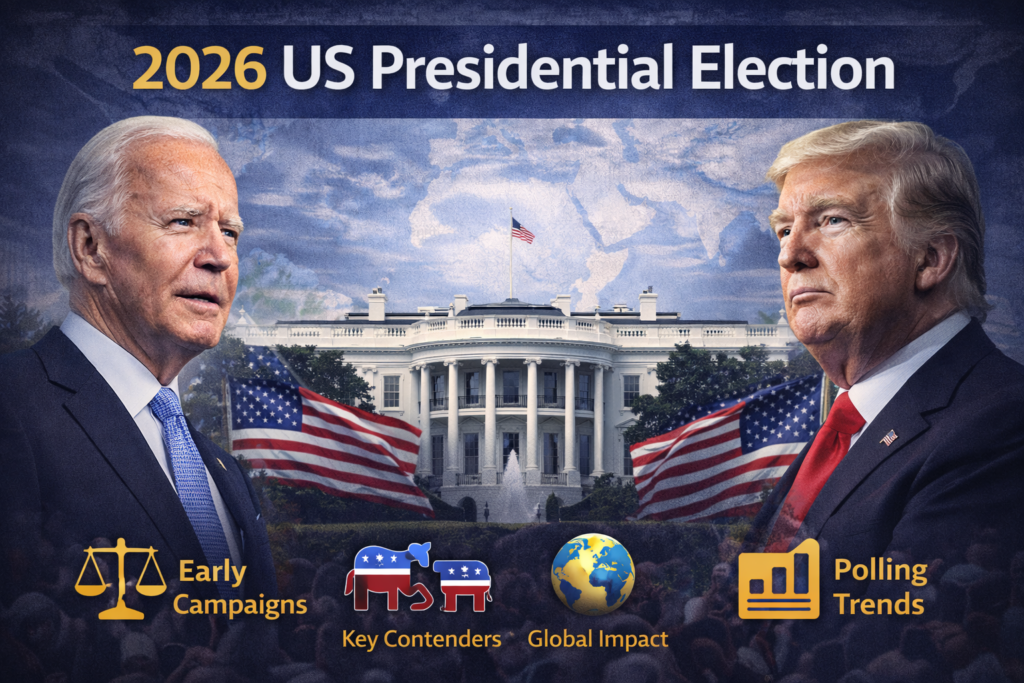
The 2026 US Presidential Election is already shaping up to be one of the most consequential political events of the decade. Even though Election Day remains months away, early campaign movements, fundraising efforts, policy positioning, and international reactions are beginning to define what could become a transformative political contest.
Unlike previous cycles, the 2026 US Presidential Election unfolds in a deeply polarized domestic climate and an increasingly complex global geopolitical environment. From economic recovery and artificial intelligence regulation to China relations and Middle East security, the outcome of this election will not only determine America’s internal trajectory but also influence global power structures.
This early analysis explores campaign strategies, key contenders, policy positioning, and the broader global implications of the 2026 US Presidential Election.
Join our social media platform
The Political Climate Entering 2026
The United States enters the 2026 US Presidential Election amid several defining challenges:
- Persistent inflationary pressures and economic restructuring
- Immigration and border security debates
- Artificial intelligence regulation and tech governance
- Ongoing geopolitical tensions involving China, Russia, and the Middle East
- Domestic political polarization
Voter fatigue, economic anxieties, and institutional trust issues are shaping early campaign messaging across party lines.
Polls indicate that independent voters may once again determine the final outcome, especially in battleground states such as:
- Pennsylvania
- Michigan
- Wisconsin
- Arizona
- Georgia
Both major parties are building strategies centered on suburban voters, working-class constituencies, and younger digital-native voters.
Key Contenders in the 2026 US Presidential Election
While the final candidate list will not be confirmed until party conventions, several figures have emerged as early frontrunners.
Republican Party
The Republican primary field appears divided between:
- Traditional conservative leadership
- Populist-nationalist candidates
- Emerging governors positioning themselves as next-generation reformers
Key themes in Republican strategy include:
- Border security
- Economic nationalism
- Energy independence
- Opposition to perceived federal overreach
- Strong stance against China
Several Republican governors and senators are building early national networks, focusing heavily on fundraising infrastructure and digital grassroots mobilization.
Democratic Party
The Democratic Party enters the 2026 US Presidential Election focused on:
- Economic stability
- Healthcare protection
- Climate policy
- Voting rights
- AI governance and tech regulation
Democratic strategists are emphasizing coalition-building across urban centers, minority communities, and younger voters. The party’s early messaging focuses on institutional stability and international alliances.
Early Campaign Strategies
The 2026 US Presidential Election is witnessing a transformation in campaign methodology.
1. Data-Driven Voter Targeting
Campaigns are investing heavily in advanced voter analytics powered by artificial intelligence. Micro-targeted advertising is now highly personalized, using behavioral modeling to craft specific messaging for distinct demographic segments.
Digital engagement strategies include:
- Short-form video content
- AI-generated policy explainers
- Interactive town halls
- Influencer partnerships
2. Fundraising Evolution
Small-dollar online fundraising remains critical. Both parties are expanding recurring micro-donation systems to maintain financial consistency throughout the campaign cycle.
Super PACs and political action committees continue to influence messaging, though transparency debates remain ongoing.
3. Battleground State Focus
The early map of the 2026 US Presidential Election suggests that campaigns are prioritizing a limited number of decisive states. Resource allocation is concentrated rather than nationwide.
Ground operations include:
- Door-to-door voter outreach
- Campus mobilization efforts
- Minority community engagement
- Faith-based outreach networks
Major Policy Issues Defining the 2026 US Presidential Election
Economic Stability
Inflation management, job creation, and interest rate stabilization are central campaign themes. Candidates are debating:
- Tax reform
- Federal spending
- Industrial policy
- Supply chain resilience
Artificial Intelligence and Technology Regulation
AI governance has emerged as a top-tier issue. The United States faces competition from China and the European Union in regulating advanced technologies.
Candidates are discussing:
- National AI strategy
- Semiconductor manufacturing incentives
- Data privacy frameworks
- Tech company accountability
Immigration and Border Policy
Immigration remains one of the most polarizing topics in the 2026 US Presidential Election. Competing visions include:
- Border wall expansion
- Comprehensive immigration reform
- Asylum processing reforms
- Work visa expansion
Foreign Policy and National Security
International conflicts heavily influence campaign rhetoric. Key global flashpoints include:
- US–China strategic competition
- NATO expansion
- Russia–Ukraine conflict
- Middle East security realignment
Candidates are framing foreign policy through economic security and energy independence narratives.
Read also: 2026 General Election Strategy: How BJP and Congress Are Reshaping State Alliances Across India
Global Impact of the 2026 US Presidential Election
The significance of the 2026 US Presidential Election extends far beyond American borders.
China Relations
Beijing closely monitors the election, as trade policy, semiconductor restrictions, and Taiwan security guarantees could shift dramatically depending on the outcome.
Markets are particularly sensitive to:
- Tariff policies
- Export controls
- Technology decoupling
Europe and NATO
European allies seek clarity on:
- Military commitments
- Ukraine support
- Defense spending expectations
The stability of transatlantic alliances may hinge on the direction of US foreign policy in 2026.
Middle East Dynamics
US diplomatic engagement in the Middle East remains pivotal. Energy markets, regional security alliances, and Iran negotiations could shift depending on the next administration.
Global Financial Markets
The 2026 US Presidential Election influences:
- US dollar strength
- Global stock markets
- Oil prices
- Interest rate expectations
Investor uncertainty often increases as election rhetoric intensifies.
Role of Media and Digital Influence
Digital ecosystems have transformed political campaigning.
The 2026 US Presidential Election is heavily influenced by:
- Social media platforms
- Podcast networks
- Alternative news outlets
- AI-generated political content
Misinformation risks remain a major concern. Both parties are investing in digital monitoring systems to combat false narratives.
Fact-checking institutions are also expanding their operations in anticipation of election-related misinformation.
Youth Vote and Demographic Shifts
Demographic evolution is reshaping the electorate.
Key trends include:
- Increased Latino voter participation
- Younger voters prioritizing climate and tech issues
- Suburban shifts in political alignment
- Growing Asian-American political engagement
The 2026 US Presidential Election may see record youth turnout if campaigns successfully mobilize first-time voters.
Independent Voters as Decisive Bloc
Independent voters represent a growing share of the electorate.
Both parties are moderating certain messaging elements to appeal to centrist voters concerned about:
- Economic pragmatism
- Institutional stability
- National unity
Swing voters could determine outcomes in closely contested states.
Potential Election Scenarios
Scenario 1: Clear Electoral Majority
One party wins decisively, providing policy stability and clearer market signals.
Scenario 2: Narrow Electoral College Outcome
Legal challenges and recounts become possible in tightly contested states.
Scenario 3: Split Government
A president from one party faces a Congress controlled by the other, limiting legislative momentum.
Each scenario carries different global implications.
Legal and Institutional Safeguards
Election security remains a high priority.
Authorities are strengthening:
- Cybersecurity infrastructure
- Voter database protections
- Disinformation monitoring
- Election transparency systems
International observers continue to study US electoral processes as democratic benchmarks.
Economic Outlook Tied to Election Outcome
Markets are pricing in potential policy changes.
Sectors particularly sensitive to election results include:
- Energy
- Technology
- Defense
- Healthcare
- Infrastructure
Business leaders are preparing contingency plans depending on regulatory direction.
Conclusion: Why the 2026 US Presidential Election Matters Globally
The 2026 US Presidential Election is not simply a domestic political contest. It is a referendum on economic management, technological governance, global alliances, and democratic stability.
Early campaign strategies indicate a highly competitive race shaped by digital innovation, demographic shifts, and global uncertainty.
As candidates refine their platforms and voters assess competing visions, the outcome will influence:
- International diplomacy
- Global markets
- Security alliances
- Technology regulation
- Climate policy
In a world increasingly interconnected, the direction chosen by American voters in 2026 will resonate far beyond its borders.
The coming months will reveal whether the election reinforces institutional continuity or signals a new political chapter in global leadership.
Read More

🚨 Gujarat Breaking: Live Updates Today
Breaking Gujarat, election updates, conflicts, peace talks, and developments.