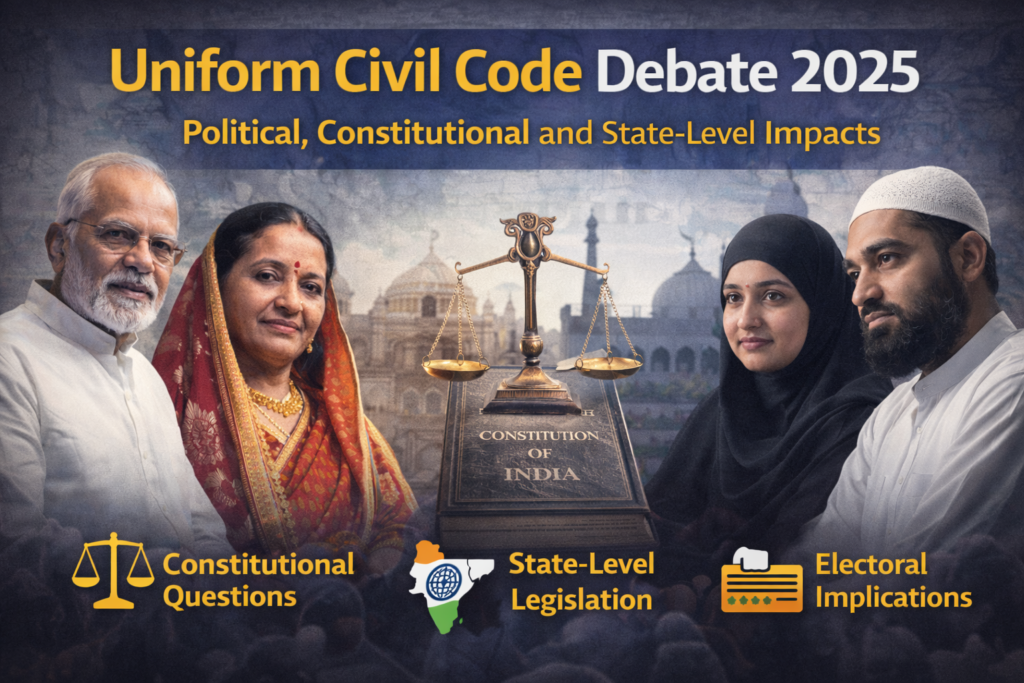
The Uniform Civil Code Debate 2025 has emerged as one of the most significant constitutional and political discussions in India. As discussions intensify at both national and state levels, the proposal continues to shape electoral narratives, legal analysis, and policy discourse.
The Uniform Civil Code (UCC) seeks to replace personal laws based on religion with a common set of civil laws governing marriage, divorce, inheritance, and adoption. While supporters argue it promotes equality and national integration, critics raise concerns regarding cultural autonomy and minority rights.
Join our social media platform
What Is the Uniform Civil Code?
The concept of a Uniform Civil Code is mentioned under Article 44 of the Indian Constitution, which states:
“The State shall endeavour to secure for the citizens a uniform civil code throughout the territory of India.”
However, Article 44 falls under the Directive Principles of State Policy, meaning it is not enforceable by courts but serves as guidance for governance.
The Uniform Civil Code Debate 2025 revolves around how and when this constitutional directive should be implemented.
Why the Uniform Civil Code Debate 2025 Has Intensified
Several factors have revived the debate:
- State-level initiatives to draft UCC legislation
- Supreme Court observations in personal law cases
- Electoral positioning ahead of national polls
- Growing public discourse around gender justice
Political parties are now framing the Uniform Civil Code Debate 2025 as either a reform for equality or a sensitive social transformation requiring consensus.
BJP’s Position in the Uniform Civil Code Debate 2025
The Bharatiya Janata Party has consistently supported the implementation of a Uniform Civil Code.
Key Arguments Presented:
- Gender equality across religious communities
- Simplification of legal frameworks
- National integration
- Elimination of discriminatory practices
State governments aligned with the BJP have begun forming expert committees to examine draft models.
Supporters argue that the Uniform Civil Code Debate 2025 reflects a constitutional commitment rather than a political move.
Congress and Opposition Position
The Congress and several opposition parties have taken a more cautious approach in the Uniform Civil Code Debate 2025.
Concerns Raised:
- Protection of minority rights
- Federal structure implications
- Need for wide consultation
- Cultural and religious sensitivities
Opposition leaders have emphasized that any reform must emerge through consensus-building rather than unilateral legislation.
State-Level Developments
The Uniform Civil Code Debate 2025 has moved beyond rhetoric into state-level legislative exploration.
Key Developments:
- Formation of expert committees
- Draft consultation processes
- Public hearings in certain states
- Legal review of personal law frameworks
These state initiatives may serve as pilot models for potential national implementation.
Constitutional and Legal Implications
The Uniform Civil Code Debate 2025 raises complex constitutional questions:
1. Federal Structure
Can states independently enact versions of a Uniform Civil Code?
2. Fundamental Rights
How will religious freedom under Article 25 interact with a uniform code?
3. Judicial Review
Any enacted UCC legislation may face constitutional challenges before the Supreme Court.
Legal scholars suggest that implementation must balance Directive Principles with Fundamental Rights protections.
Electoral Implications of the Uniform Civil Code Debate 2025
With general elections approaching, the debate has significant political impact.
Potential Electoral Effects:
- Consolidation of ideological voter bases
- Polarization in certain regions
- Mobilization around gender justice narratives
- Coalition positioning among regional parties
The Uniform Civil Code Debate 2025 may become a central theme in campaign manifestos.
Public Opinion and Civil Society Reactions
Civil society responses are mixed.
Supporters highlight:
- Women’s rights reform
- Simplified legal processes
- Removal of discriminatory inheritance practices
Critics argue:
- Cultural pluralism must be preserved
- Gradual reform is preferable
- Community consultation is essential
The debate remains deeply nuanced rather than binary.
International Comparisons
Many countries operate under unified civil law systems. However, India’s pluralistic legal tradition makes the Uniform Civil Code Debate 2025 uniquely complex.
Comparative examples are often cited but may not directly translate to India’s socio-religious diversity.
Economic and Administrative Impact
A Uniform Civil Code could:
- Streamline judicial processes
- Reduce litigation complexities
- Standardize documentation systems
However, transition challenges could include:
- Legal training adjustments
- Administrative restructuring
- Public awareness campaigns
What Happens Next?
Possible future developments include:
- State-level legislation rollout
- Supreme Court guidance
- Parliamentary debate
- Expert committee reports
The Uniform Civil Code Debate 2025 is likely to evolve over the coming months.
Frequently Asked Questions (FAQ)
Is Uniform Civil Code mandatory under the Constitution?
No. It is mentioned under Directive Principles and is not legally enforceable.
Can states implement their own UCC?
States may attempt reforms within their legislative competence, but constitutional review may follow.
Does UCC abolish religious practices?
The debate centers around civil laws, not religious rituals.
Conclusion
The Uniform Civil Code Debate 2025 represents a pivotal constitutional and political moment in India. Balancing equality, religious freedom, and federal principles will require careful legislative design and broad consultation.
As political parties refine their positions, the outcome of this debate may significantly influence policy direction and electoral narratives in the coming years.
Read More

🚨 Gujarat Breaking: Live Updates Today
Breaking Gujarat, election updates, conflicts, peace talks, and developments.