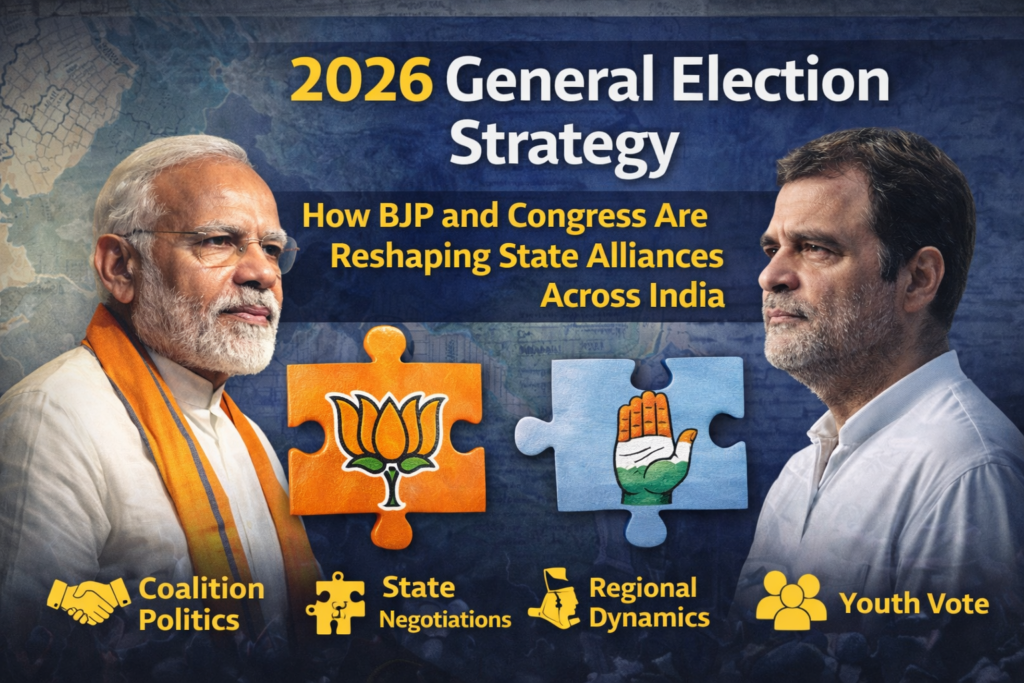
India’s political landscape is already witnessing early realignments as parties prepare their 2026 General Election Strategy. With national elections approaching, both the Bharatiya Janata Party (BJP) and the Congress are recalibrating alliances, regional partnerships, and campaign narratives.
The coming months are expected to redefine coalition equations across key states, making the 2026 General Election Strategy one of the most closely watched political developments in India.
Join our social media platform
Why the 2026 General Election Strategy Matters
Unlike previous election cycles, the 2026 General Election Strategy is being shaped by:
- Regional party consolidation
- Coalition politics revival
- Economic performance debates
- Youth voter influence
- Social welfare policy positioning
Both national parties understand that state-level alliances will determine the final arithmetic in Parliament.
BJP’s 2026 General Election Strategy
The BJP’s 2026 General Election Strategy focuses on expanding its footprint in southern and eastern states while consolidating dominance in the Hindi heartland.
Key Strategic Pillars:
1. Strengthening the NDA Bloc
The National Democratic Alliance (NDA) is being revitalized with renewed outreach to regional players. Seat-sharing negotiations are expected to be more flexible compared to earlier cycles.
2. Southern Expansion
States such as Tamil Nadu, Kerala, and Telangana remain strategic targets. The BJP is focusing on regional partnerships and grassroots organizational growth.
3. Welfare and Infrastructure Narrative
The 2026 General Election Strategy for BJP heavily emphasizes infrastructure growth, digital governance, and welfare delivery.
4. Youth and First-Time Voters
With millions of new voters entering the electorate, digital campaigning and employment-focused messaging are central to strategy planning.
Congress and Opposition’s 2026 General Election Strategy
For Congress and allied opposition parties, the 2026 General Election Strategy revolves around coalition arithmetic and issue-based mobilization.
Core Elements Include:
1. Strengthening INDIA Bloc Coordination
Opposition unity remains a work in progress. Seat-sharing negotiations across states like Maharashtra, Bihar, and West Bengal are crucial.
2. Economic and Social Justice Narrative
Congress is emphasizing unemployment, inflation, and social equity as central themes.
3. Regional Party Leverage
Regional leaders hold significant bargaining power in the 2026 General Election Strategy. States such as Tamil Nadu, Bihar, and Karnataka may determine national outcomes.
4. Caste Census and Welfare Politics
Identity-based mobilization could become a significant element of campaign planning.
State-Level Alliance Dynamics
The 2026 General Election Strategy cannot be understood without examining state politics.
Maharashtra
Alliance realignments remain fluid, with coalition stability influencing parliamentary outcomes.
Bihar
Caste equations and shifting alliances will likely dominate strategic discussions.
Uttar Pradesh
Given its parliamentary weight, UP remains central to both BJP and opposition planning.
Tamil Nadu
Dravidian party alignments will play a decisive role in southern electoral calculations.
Key Factors Influencing the 2026 General Election Strategy
Several macro factors will influence final strategies:
- Economic growth performance
- Inflation and rural income trends
- Supreme Court rulings affecting political funding
- Digital misinformation regulations
- Geopolitical developments
The interplay of governance performance and coalition arithmetic will shape campaign narratives.
Role of Technology in the 2026 General Election Strategy
Political campaigning in 2026 is expected to be more data-driven than ever before.
Major components include:
- AI-powered voter analytics
- Social media micro-targeting
- WhatsApp and regional messaging networks
- Digital volunteer mobilization
Both BJP and Congress are investing heavily in digital outreach infrastructure.
Electoral Bonds and Transparency Debate
Political funding transparency remains a major discussion point. Any new regulatory developments could significantly impact the 2026 General Election Strategy.
Public perception around funding reforms may influence voter trust.
Youth Voters and Urban Influence
India’s demographic structure continues to favor a young electorate.
Key focus areas include:
- Startup ecosystem support
- Employment generation
- Education policy reforms
- Skill development initiatives
Youth turnout could decisively impact marginal constituencies.
What Makes 2026 Different?
The 2026 General Election Strategy is unique because:
- Coalition politics is resurging
- Regional parties are stronger
- Digital campaigning has matured
- Policy debates are more data-centric
Unlike previous elections dominated by singular narratives, 2026 may witness multi-layered regional strategies.
Possible Scenarios for 2026
- Consolidated NDA majority
- Fragmented mandate with strong regional influence
- Tight coalition arithmetic leading to post-election negotiations
Political observers suggest that pre-election alliances will heavily influence final results.
Read also: Powerful Guide: Tarbandi Yojana 2025 के लिए Complete आवेदन प्रक्रिया
Conclusion
The 2026 General Election Strategy is already shaping India’s political discourse. BJP and Congress are repositioning alliances, strengthening regional ties, and refining policy messaging to gain electoral advantage.
As coalition negotiations intensify and state elections unfold, the strategic roadmap for 2026 will continue to evolve.
India’s next general election may ultimately be decided not only by national narratives but by carefully negotiated state-level alliances.
Read More
🚨 Gujarat Breaking: Live Updates Today
Breaking Gujarat, election updates, conflicts, peace talks, and developments.